
How to Tell High Desert Wind Has Compromised an Aztec Roof
Sustained spring wind and blowing grit do most of their damage quietly, long before a shingle goes missing.
Request a roofing estimate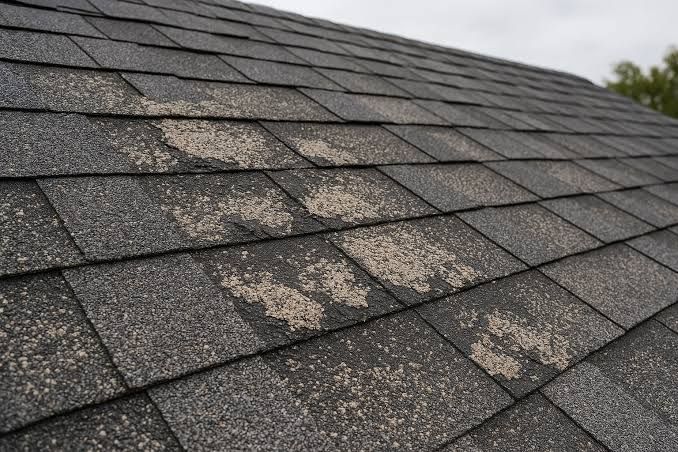
Wind in the Four Corners is not an occasional event. From late winter through May, sustained wind is simply the weather, and an Aztec roof absorbs it for weeks at a stretch rather than for the few hours a thunderstorm lasts somewhere else.
That changes what wind damage looks like here. A roof in a humid climate takes one hard hit and either survives or visibly fails. A roof in San Juan County takes thousands of hours of pressure cycling and abrasive loading, and the damage accumulates in ways that are genuinely difficult to recognize from the driveway.
In this guide
Seal strip failure, the damage that leaves no trace
Asphalt shingles are held flat to each other by a strip of adhesive that bonds each course to the one below. That bond is what makes a roof a continuous surface instead of a stack of individual tabs.
Sustained wind flexes shingles upward repeatedly. Each flex puts stress on that adhesive bond, and after enough cycles the bond releases. The shingle settles back into position looking entirely normal. It is now held by its nails alone.
Here is why this matters more in Aztec than in most places. A single storm elsewhere might break seals on an exposed edge. A Four Corners spring subjects the whole roof to that flexing for weeks. The result can be widespread seal failure across entire slopes, with nothing out of place and nothing leaking, on a roof that will shed shingles in the next significant gust.
Checking it requires lifting shingle edges by hand at multiple points across every slope. There is no way to see it from the ground, and photographs will not show it either.
Windborne grit, which is specific to this landscape
This is the mechanism most homeowners have never heard of, and it is one of the more consequential ones in the high desert.
Wind here carries sand and fine grit. Sustained wind loaded with abrasive particles works on a shingle surface the way a slow sandblaster would, scouring granules off the exposed face. The granule layer is the only thing standing between the asphalt and the sun, and at this elevation the sun is unforgiving.
The pattern is distinctive. Abrasion loss concentrates on the slopes facing the prevailing wind, and it is broad and even rather than appearing as discrete impact points the way hail damage does. A roof with a west or southwest slope noticeably more worn than the rest is usually telling you about years of abrasive wind rather than about a single storm.
Checking the gutters is useful but needs interpretation. Granule accumulation after a wind event is normal to a degree, since all roofs shed some. Heavy accumulation, repeatedly, from the windward slopes points at abrasion rather than at ordinary aging.
Where wind lifts first on an Aztec roof
Wind pressure is not distributed evenly, and the places it concentrates are not where most people look.
Air flowing over a roof generates the strongest uplift along the rake edges and at the eave. The middle of a slope, surrounded by other shingles, is comparatively sheltered. So the perimeter is where failures begin, and a roof inspected only in its visible middle sections can pass while its edges are compromised.
Ridge and hip caps are next. They sit at the peak with exposure on two sides, they catch wind from more directions than field shingles, and they are folded over a bend that is thinner than the rest of the shingle. Cracked or displaced ridge cap after a windy spring is one of the most common findings on roofs across Aztec and the wider San Juan County area.
Starter shingles at the eave matter more than their cost suggests. They provide a sealed base at the roof's most vulnerable edge. A roof installed without quality starter, or with the starter strip positioned wrong, is exposed at exactly the point where uplift is highest.
Flashing, and the joints wind works loose
Every place the roof meets something else is handled by metal rather than by shingles: chimneys, walls, skylights, valleys, vent penetrations. Wind gets at the edges of those details and works them.
A quarter inch of separation at a step flashing joint is invisible from the ground and will admit water in every rain from that point forward. In this climate the rain arrives concentrated during monsoon season, which means a joint that opened in April gets tested hard in July.
Sealant is the related vulnerability. Sealant at flashing details has a finite service life, and at Four Corners altitude with this UV exposure it is on the short end of the range. Wind-induced movement at a joint accelerates that failure further. A detail relying on old sealant and holding against wind flexing is a detail on a clock.
What the damage does over a full year
Understanding the sequence explains why wind damage here tends to surface long after the wind.
Spring wind breaks seals and abrades granules. Summer sun then attacks the asphalt exposed by that granule loss, and at this elevation UV intensity is substantially higher than at sea level, so oxidation runs fast. The asphalt hardens and begins to crack.
Monsoon rain arrives and finds the unsealed shingle edges and the opened flashing joints. Winter brings freeze-thaw, and water sitting in those cracks expands when it freezes, widening them. By the following spring the roof is measurably worse, and another wind season starts.
That cycle is why an Aztec roof inspected after wind season, rather than after a leak, is worth the appointment. Finding broken seals in May means they get addressed before the sun and the monsoon compound them.
Magic Roofing & Construction
Magic Roofing & Construction has worked across the Four Corners since 2007, licensed and insured under licence 364022, with a team of 15 to 20 local people and more than 150 years of combined experience. We are a Malarkey Certified Pro Contractor, a CertainTeed ShingleMaster, an Owens Corning Preferred Contractor and a Tremco Certified Installer, and we hold an A plus rating with the BBB. Call (505) 324-1094 for a wind damage assessment.
After a hard wind season, schedule a storm damage roof assessment and we will check seals and flashing across every slope rather than only where damage shows.
Roof repair in Aztec, NM
Homes across Aztec contend with the same sustained spring wind, the same abrasive grit, and the same high altitude sun working on whatever the wind exposed. An inspection aimed at that combination finds things a generic checklist misses.
Contact our team about residential roof repair for your Aztec home.
Frequently Asked Questions
How do I know if wind damaged my Aztec roof when nothing looks wrong?
The most common wind damage is seal strip failure, where the adhesive bonding shingles together releases while the shingle settles back looking normal. It is held by nails alone after that and will lift in the next strong gust. Finding it means lifting shingle edges by hand across every slope, which cannot be done from the ground or from photographs.
What is windborne grit abrasion and why does it matter here?
Four Corners wind carries sand and fine grit that scours granules off shingle surfaces over sustained exposure, acting like a slow sandblaster. The granule layer is the only protection the asphalt has from this elevation's intense sun. The pattern is broad, even loss concentrated on slopes facing prevailing wind, unlike hail which leaves discrete impact points.
Which parts of a roof fail first in high desert wind?
The edges, which surprises most homeowners. Air moving over a roof creates the strongest uplift along rake edges and at the eave, while the middle of a slope is comparatively sheltered. Ridge and hip caps are next, exposed on two sides and folded over a thin bend. A roof can pass a mid-slope look while its perimeter is compromised.
Why does wind damage show up months later in the Four Corners?
Spring wind breaks seals and abrades granules. Summer UV at this altitude then attacks the exposed asphalt fast, hardening and cracking it. Monsoon rain finds the unsealed edges and opened flashing. Winter freeze-thaw widens the cracks. The leak appears a year or more after the wind that started it, which is why post-season inspection matters.
When should I have my roof inspected in Aztec?
After wind season, meaning late spring, rather than waiting for a leak. Finding broken seals and abrasion in May means they get addressed before summer sun and monsoon rain compound the damage. An inspection then either confirms the roof is sound, which is worth knowing, or catches problems at the stage where they are still repairs.
How much granule loss in my gutters is normal?
Some shedding is normal on any roof, so accumulation after a wind event is not automatically a problem. What points at abrasion is heavy accumulation, occurring repeatedly, and coming predominantly from the slopes facing prevailing wind. Pairing that with a visible difference in wear between windward and sheltered slopes is the clearer indicator.
Get your roof checked after wind season
We look at seal strips, edges, ridge caps and flashing on every slope, so hidden wind damage gets found while it is still a repair. Call (505) 324-1094 or contact us online.
Request a roofing estimate